# Astronomy Picture of the Day
**URL:** https://forum.eternagame.org/t/astronomy-picture-of-the-day/3754
**Category:** General Science Discussion
**Created:** [January 4, 2021, 2:39am UTC](https://forum.eternagame.org/t/astronomy-picture-of-the-day/3754 "2021-01-04T02:39:53Z")
**Posts on this page:** 12
**Page:** 1
### Author:  [@JPS838898](https://forum.eternagame.org/u/JPS838898)
#### Post date: [January 4, 2021, 2:39am UTC](https://forum.eternagame.org/t/astronomy-picture-of-the-day/3754/1 "2021-01-04T02:39:53Z")
i’m starting this as i want to post here the [APOD](https://apod.nasa.gov) of the day for everyday so i will post here be sure to set this topic to watching so you get notified of all posts on this topic
---
### Author:  [@whbob](https://forum.eternagame.org/u/whbob)
#### Post date: [January 4, 2021, 4:34pm UTC](https://forum.eternagame.org/t/astronomy-picture-of-the-day/3754/2 "2021-01-04T16:34:20Z")
looks like the cloud to ground charges are creating an upward positron storm 🙂
---
### Author:  [@JPS838898](https://forum.eternagame.org/u/JPS838898)
#### Post date: [January 4, 2021, 6:28pm UTC](https://forum.eternagame.org/t/astronomy-picture-of-the-day/3754/3 "2021-01-04T18:28:47Z")
[APOD](https://apod.nasa.gov/)
[ ](https://www.youtube.com/watch?v=zS_XgF9i8tc)
Sprite Lightning at 100,000 Frames Per Second
Video Credit & Copyright: Matthew G McHarg, Jacob L Harley, Thomas Ashcraft, Hans Nielsen
Explanation: What causes sprite lightning? Mysterious bursts of light in the sky that momentarily resemble gigantic jellyfish have been recorded for over 30 years, but apart from a general association with positive cloud-to-ground lightning, their root cause remains unknown. Some thunderstorms have them – most don’t. Recently, however, high speed videos are better detailing how sprites actually develop. The featured video, captured in mid-2019, is fast enough – at about 100,000 frames per second – to time-resolve several sprite “bombs” dropping and developing into the multi-pronged streamers that appear on still images. Unfortunately, the visual clues provided by videos like these do not fully resolve the sprite origins mystery. High speed vidoes do indicate to some researchers, though, that sprites are more likely to occur when plasma irregularities exist in the upper atmosphere.
---
### Author:  [@JPS838898](https://forum.eternagame.org/u/JPS838898)
#### Post date: [January 5, 2021, 6:49pm UTC](https://forum.eternagame.org/t/astronomy-picture-of-the-day/3754/4 "2021-01-05T18:49:32Z")
[APOD](https://apod.nasa.gov/apod/ap210105.html)
[https://apod.nasa.gov/apod/image/2101/SMC\_Mtanous\_4464.jpg(image larger than 4 MB)](https://apod.nasa.gov/apod/image/2101/SMC_Mtanous_4464.jpg)
**The Small Cloud of Magellan**
**Image Credit & Copyright:** [José Mtanous](https://mtanous.wordpress.com/about/)
**Explanation:** What is the Small Magellanic Cloud? It has turned out to be a galaxy. People who have wondered about this little fuzzy patch in the southern sky included Portuguese navigator [Ferdinand Magellan](http://www.fordham.edu/halsall/mod/1519magellan.html) and his crew, who had plenty of time to study the unfamiliar night sky of the south during the first circumnavigation of [planet Earth](https://solarsystem.nasa.gov/planets/earth/overview/) in the early 1500s. As a result, two [celestial wonders](https://i.imgur.com/28TqRVc.jpg) easily visible for southern hemisphere [skygazers](https://apod.nasa.gov/apod/ap040808.html) are now known in [Western culture](https://en.wikipedia.org/wiki/Western_culture) as the Clouds of Magellan. Within the past [100 years](https://apod.nasa.gov/debate/debate100th.html), research has shown that these cosmic clouds are dwarf [irregular galaxies](https://en.wikipedia.org/wiki/Irregular_galaxy), [satellites of our larger spiral](http://www.atlasoftheuniverse.com/sattelit.html) Milky Way Galaxy. The [Small Magellanic Cloud](https://en.wikipedia.org/wiki/Small_Magellanic_Cloud) actually spans 15,000 light-years or so and contains several hundred million stars. About 210,000 light-years away in the constellation of the [Tucan](https://en.wikipedia.org/wiki/Toucan#/media/File:-_panoramio_-_Basa_Roland.jpg) ([Tucana](http://www.hawastsoc.org/deepsky/tuc/)), it is more distant than other known [Milky Way satellite galaxies](https://en.wikipedia.org/wiki/Satellite_galaxies_of_the_Milky_Way), including the [Sagittarius Dwarf](https://en.wikipedia.org/wiki/Sagittarius_Dwarf_Spheroidal_Galaxy) galaxy and the [Large Magellanic Cloud](https://apod.nasa.gov/apod/ap190905.html). [This sharp image](https://mtanous.wordpress.com/#jp-carousel-1295) also includes the foreground globular star cluster [47 Tucanae](https://apod.nasa.gov/apod/ap201024.html) on the right.
---
### Author:  [@JPS838898](https://forum.eternagame.org/u/JPS838898)
#### Post date: [January 6, 2021, 7:07pm UTC](https://forum.eternagame.org/t/astronomy-picture-of-the-day/3754/5 "2021-01-06T19:07:27Z")
[APOD](https://apod.nasa.gov/)

**Striped Sand Dunes on Mars**
**Image Credit:** [HiRISE](https://hirise.lpl.arizona.edu/), [MRO](https://mars.jpl.nasa.gov/mro/), [LPL (U. Arizona)](https://www.lpl.arizona.edu/), [NASA](https://www.nasa.gov/); _Processing:_[Włodek Głażewski](https://www.flickr.com/people/158004304@N05/);
_Text:_[Alex R. Howe](https://sciencemeetsfiction.com/about/) ([NASA](https://www.nasa.gov/)/[USRA](https://www.usra.edu/), [Reader’s History of SciFi](http://readershistoryofscifi.libsyn.com/) Podcast)
**Explanation:** Why are these sand dunes on Mars striped? No one is sure. The [featured image](https://www.uahirise.org/ESP_066476_2370) shows striped dunes in [Kunowsky Crater](https://en.wikipedia.org/wiki/Kunowsky_(Martian_crater)) on Mars, photographed recently with the [Mars Reconnaissance Orbiter’s](https://mars.nasa.gov/mro/) HiRISE Camera. Many Martian dunes are known to be covered unevenly with carbon dioxide ([dry ice](https://en.wikipedia.org/wiki/Dry_ice)) frost, creating patterns of light and dark areas. Carbon dioxide doesn’t melt, but [sublimates](https://en.wikipedia.org/wiki/Sublimation_(phase_transition)), turning directly into a gas. Carbon dioxide is also a [greenhouse material](https://en.wikipedia.org/wiki/Greenhouse_gas) even as a solid, so it can trap heat under the ice and [sublimate](https://youtu.be/L_gnxWUuLm0) from the bottom up, causing [geyser-like eruptions](https://en.wikipedia.org/wiki/Geysers_on_Mars). During Martian spring, these eruptions can cause a pattern of dark [defrosting spots](https://apod.nasa.gov/apod/ap070805.html), where the [darker sand](https://apod.nasa.gov/apod/ap160119.html) is exposed. The [featured image](https://www.flickr.com/photos/186557130@N06/50642211592/in/pool-apods/), though, was taken during Martian autumn, when the weather is getting colder – making these stripes particularly puzzling. One hypothesis is that they are caused by cracks in the ice that form from weaker eruptions or [thermal stress](https://en.wikipedia.org/wiki/Thermal_stress) as part of the day-night cycle, but research continues. Watching these dunes and others through more [Martian seasons](https://www.msss.com/http/ps/seasons/seasons.html) may give us more clues to solve this mystery.
---
### Author:  [@JPS838898](https://forum.eternagame.org/u/JPS838898)
#### Post date: [January 8, 2021, 8:10pm UTC](https://forum.eternagame.org/t/astronomy-picture-of-the-day/3754/6 "2021-01-08T20:10:41Z")
sry havent been posting ina while
here is [APOD](https://apod.nasa.gov/)
2021-01-07T08:00:00Z

**Total Solar Eclipse 2020**
**Image Credit & [Copyright](https://apod.nasa.gov/apod/lib/about_apod.html#srapply):**[Miloslav Druckmuller](http://www.zam.fme.vutbr.cz/~druck/Index.htm), Andreas Moller, ([Brno University of Technology](http://www.vutbr.cz/en/)),
**Explanation:** [Along a narrow path](https://apod.nasa.gov/apod/ap201229.html) crossing southern South America through Chile and Argentina, the final New Moon of 2020 moved in front of the Sun on December 14 in the year’s only [total solar eclipse](https://apod.nasa.gov/apod/ap201218.html). Within about 2 days of perigee, the closest point in its elliptical orbit, the New Moon’s surface is faintly [lit by earthshine](https://apod.nasa.gov/apod/ap170831.html) in this dramatic composite view. [The image is a processed composite](http://www.zam.fme.vutbr.cz/~druck/Eclipse/Ecl2020a/Tse2020_400mm_wa/0-info.htm) of 55 calibrated exposures ranging from 1/640 to 3 seconds. Covering a large range in brightness during totality, it reveals the dim lunar surface and faint background stars, along with [planet-sized](https://www.nasa.gov/content/goddard/what-is-a-solar-prominence) prominences at the Sun’s edge, an enormous [coronal mass ejection](https://solarscience.msfc.nasa.gov/CMEs.shtml), and sweeping coronal structures normally hidden in the Sun’s glare. [Look closely](https://www.nasa.gov/feature/goddard/2020/recently-discovered-comet-seen-during-2020-total-solar-eclipse-SOHO/) for an ill-fated sungrazing Kreutz family comet (C/2020 X3 SOHO) approaching from the lower left, at about the 7 o’clock position. In 2021 eclipse chasers will see an annular solar eclipse coming up on June 10. They’ll have to wait until December 4 for the only total solar eclipse in 2021 though. [That eclipse will be](https://eclipse.gsfc.nasa.gov/SEplot/SEplot2001/SE2021Dec04T.GIF) total along a narrow path crossing the southernmost continent of Antarctica.
2021-01-08T08:00:00Z
[https://apod.nasa.gov/apod/image/2101/NGC-1365-RGB-19-DEC-2020\_Leo\_Mike.jpg(image larger than 4 MB)](https://apod.nasa.gov/apod/image/2101/NGC-1365-RGB-19-DEC-2020_Leo_Mike.jpg)
**NGC 1365: Majestic Island Universe**
**Image Credit & [Copyright](https://apod.nasa.gov/apod/lib/about_apod.html#srapply):** Mike Selby, Leonardo Orazi
**Explanation:** Barred spiral galaxy NGC 1365 is truly a majestic [island universe](https://apod.nasa.gov/apod/ap100109.html) some 200,000 light-years across. Located a mere 60 million light-years away toward the chemical constellation [Fornax](http://www.hawastsoc.org/deepsky/for/index.html), NGC 1365 is a [dominant member](https://apod.nasa.gov/apod/ap160611.html) of the well-studied [Fornax Cluster of galaxies](http://heritage.stsci.edu/2005/09/supplemental.html). This impressively [sharp color image](http://www.starkeeper.it/NGC1365.htm) shows the intense, reddish star forming regions near the ends of central bar and along the spiral arms, with details of the obscuring dust lanes cutting across the galaxy’s bright core. At the core lies a supermassive black hole. Astronomers think [NGC 1365’s](http://arxiv.org/abs/0907.2602) prominent bar plays a crucial role in the [galaxy’s evolution](http://hubblesite.org/newscenter/archive/releases/1999/34/), drawing gas and dust into a star-forming maelstrom and ultimately feeding material into the [central black hole](http://hubblesite.org/newscenter/archive/releases/2000/22).
---
### Author:  [@JPS838898](https://forum.eternagame.org/u/JPS838898)
#### Post date: [January 10, 2021, 1:59am UTC](https://forum.eternagame.org/t/astronomy-picture-of-the-day/3754/7 "2021-01-10T01:59:47Z")
[Apod](https://apod.nasa.gov/)
2021-01-09T08:00:00Z

**Titan: Moon over Saturn**
**Image Credit:** [NASA](https://www.nasa.gov/), [JPL-Caltech](http://www.jpl.nasa.gov/), [Space Science Institute](http://www.spacescience.org/index.php)
**Explanation:** Like Earth’s moon, [Saturn’s largest moon Titan](https://solarsystem.nasa.gov/moons/saturn-moons/titan/in-depth/) is locked in synchronous rotation. [This mosaic](https://photojournal.jpl.nasa.gov/catalog/PIA19642) of images recorded by the Cassini spacecraft in May of 2012 shows its anti-Saturn side, the side [always facing](https://apod.nasa.gov/apod/ap161230.html) away from the ringed gas giant. The only moon in the solar system with a dense atmosphere, Titan is the only [solar system world](https://apod.nasa.gov/apod/ap141124.html) besides Earth known to have standing bodies of liquid on its surface and an earthlike cycle of [liquid rain](https://apod.nasa.gov/apod/ap110401.html) and evaporation. Its high altitude layer of atmospheric haze is evident in the Cassini view of the 5,000 kilometer diameter moon over Saturn’s rings and cloud tops. [Near center is](https://photojournal.jpl.nasa.gov/catalog/PIA20713) the dark dune-filled region known as [Shangri-La](https://solarsystem.nasa.gov/resources/17499/dunes-of-shangri-la-on-titan/). The Cassini-delivered Huygens probe rests below and left of center, after the [most distant landing](https://apod.nasa.gov/apod/ap150116.html) for a spacecraft from Earth.
---
### Author:  [@JPS838898](https://forum.eternagame.org/u/JPS838898)
#### Post date: [January 11, 2021, 6:55pm UTC](https://forum.eternagame.org/t/astronomy-picture-of-the-day/3754/8 "2021-01-11T18:55:54Z")
[APOD](https://apod.nasa.gov/)
2021-01-10T08:00:00Z

**Star Cluster R136 Breaks Out**
**Image Credit:** [NASA](http://www.nasa.gov/), [ESA](http://www.spacetelescope.org/), & [F. Paresce](http://heritage.stsci.edu/2009/32/bio/bio_primary.html) ([INAF-IASF](http://www.iasfbo.inaf.it/)), [R. O’Connell](http://www.astro.virginia.edu/~rwo/) ([U. Virginia](http://www.astro.virginia.edu/)) et al.
**Explanation:** In the center of nearby star-forming region lies a huge cluster containing some of the largest, hottest, and most massive stars known. These stars, known collectively as [star cluster R136](https://en.wikipedia.org/wiki/R136), part of the Tarantula Nebula, were captured in the [featured image](https://hubblesite.org/newscenter/archive/releases/2009/32/image/a/) in [visible light](https://science.nasa.gov/ems/09_visiblelight) in 2009 through the [Hubble Space Telescope](https://apod.nasa.gov/apod/ap010806.html). Gas and [dust](https://apod.nasa.gov/apod/ap030706.html) clouds in the [Tarantula Nebula](https://en.wikipedia.org/wiki/Tarantula), have been sculpted into [elongated shape](https://i.kym-cdn.com/photos/images/newsfeed/000/002/110/longcat.jpg?1241726484)s by powerful [winds](https://solarsystem.nasa.gov/resources/2288/the-solar-wind-across-our-solar-system/) and [ultraviolet radiation](https://science.nasa.gov/ems/10_ultravioletwaves) from these hot cluster stars. The [Tarantula Nebula](https://apod.nasa.gov/apod/ap090331.html) lies [within a neighboring galaxy](https://www.youtube.com/watch?v=Xsq1oaehLG4) known as the [Large Magellanic Cloud](https://apod.nasa.gov/apod/ap150827.html) and is located a mere 170,000 [light-years](http://starchild.gsfc.nasa.gov/docs/StarChild/questions/question19.html) away.
2021-01-11T08:00:00Z
[ ](https://www.youtube.com/watch?v=8XV2-pmiyAg)
**Moon Phases in 2021**
**Video Credit:** _Data:_[Lunar Reconnaissance Orbiter](https://lunar.gsfc.nasa.gov/) ; _Animation:_[NASA](https://www.nasa.gov/)’s [Scientific Visualization Studio](https://svs.gsfc.nasa.gov/);
_Music:_[Brandenburg Concerto No4-1 BWV1049](https://en.wikipedia.org/wiki/Brandenburg_Concertos#No._4_in_G_major,_BWV_1049) ([Johann Sebastian Bach](https://en.wikipedia.org/wiki/Johann_Sebastian_Bach)), by [Kevin MacLeod](https://incompetech.com/email.html) via [Incompetech](https://incompetech.com/)
**Explanation:** What will the Moon phase be on your birthday this year? It is [hard to predict](https://vcahospitals.com/-/media/vca/images/lifelearn-images-foldered/10812/cognition2.jpg?la=en&hash=69D0BDA985281F5E7A93F87A8B783C90) because the [Moon’s appearance](https://apod.nasa.gov/apod/ap160201.html) changes nightly. As the [Moon](https://solarsystem.nasa.gov/moons/earths-moon/overview/) orbits the [Earth](https://apod.nasa.gov/apod/ap070325.html), the half illuminated by the [Sun](https://en.wikipedia.org/wiki/Sun) first becomes increasingly visible, then decreasingly visible. The [featured video](https://svs.gsfc.nasa.gov/4874) animates images taken by NASA’s Moon-orbiting [Lunar Reconnaissance Orbiter](https://lunar.gsfc.nasa.gov/about.html) to show all 12 lunations that appear this year, 2021. A single [lunation](https://en.wikipedia.org/wiki/Lunation) describes one full cycle of our Moon, including all of its [phases](https://spaceplace.nasa.gov/review/dr-marc-earth/Moon_phases_drawing.gif). A full [lunation](http://www.inconstantmoon.com/not_phas.htm) takes about 29.5 days, just under a month ([moon-th](https://www.phrases.org.uk/bulletin_board/11/messages/229.html)). As each [lunation](https://scienceworld.wolfram.com/astronomy/Lunation.html) progresses, sunlight reflects from the [Moon](https://apod.nasa.gov/apod/moon.html) at different angles, and so [illuminates different](https://apod.nasa.gov/apod/ap180522.html) features differently. During all of this, of course, the [Moon](https://en.wikipedia.org/wiki/Moon) always keeps the same face toward the [Earth](https://apod.nasa.gov/apod/ap171204.html). What is less apparent night-to-night is that the [Moon](http://www.astronomycafe.net/qadir/amoonm.html)’s apparent size changes slightly, and that a slight wobble called a [libration](https://en.wikipedia.org/wiki/Libration) occurs as the [Moon](https://apod.nasa.gov/apod/ap180318.html) progresses along its [elliptical orbit](http://galileoandeinstein.phys.virginia.edu/more_stuff/Applets/Kepler/kepler.html).
**APOD online webinar January 12:** [Free registration, hosted by Amateur Astronomers Association of New York](https://members.aaa.org/event-4087594).
---
### Author:  [@JPS838898](https://forum.eternagame.org/u/JPS838898)
#### Post date: [January 12, 2021, 9:03pm UTC](https://forum.eternagame.org/t/astronomy-picture-of-the-day/3754/9 "2021-01-12T21:03:44Z")
[APOD](https://apod.nasa.gov/)
2021-01-12T08:00:00Z

**A Historic Brazilian Constellation**
**Image Credit & Copyright:** [Rodrigo Guerra](https://www.instagram.com/rodrigoguerra13/)
**Explanation:** The night sky is filled with stories. Cultures throughout history have projected some of their most enduring legends onto the [stars](https://science.nasa.gov/astrophysics/focus-areas/how-do-stars-form-and-evolve) above. Generations of people see these stellar constellations, hear the associated stories, and pass them down. Featured here is the perhaps [unfamiliar constellation](https://www.jstor.org/stable/43392390) of the Old Man, long recognized by the [Tupi peoples](https://en.wikipedia.org/wiki/Tupi_people) native to regions of [South America](https://en.wikipedia.org/wiki/South_America) now known as [Brazil](https://en.wikipedia.org/wiki/Brazil). The Old Man, in more modern vernacular, may be composed of the [Hyades star cluster](https://apod.nasa.gov/apod/ap191206.html) as his head and the [belt of Orion](https://apod.nasa.gov/apod/ap161204.html) as part of one leg. Tupi [folklore](https://stephaniechauvin.com/therheaconstellation) relates that the other leg was cut off by his unhappy wife, causing it to end at the orange star now known as [Betelgeuse](https://apod.nasa.gov/apod/ap200101.html). The [Pleiades star cluster](https://apod.nasa.gov/apod/ap190901.html), on the far left, can be interpreted as a head feather. In the [featured image](https://www.instagram.com/p/CJmcT3WFshc/), the hobbled Old Man is mirrored by a person posing in the foreground. [Folklore of the night sky](https://www.lpi.usra.edu/education/skytellers/) is important for many reasons, including that it records [cultural heritage](https://en.wikipedia.org/wiki/Cultural_heritage) and documents the universality of [human](https://apod.nasa.gov/apod/ap190818.html) intelligence and imagination.
---
### Author:  [@JPS838898](https://forum.eternagame.org/u/JPS838898)
#### Post date: [January 19, 2021, 1:43am UTC](https://forum.eternagame.org/t/astronomy-picture-of-the-day/3754/10 "2021-01-19T01:43:59Z")
2021-01-13T08:00:00Z

**Arches Across an Arctic Sky**
**Image Credit & Copyright:** [Giulio Cobianchi](https://giuliocobianchi.com/about/)
**Explanation:** What are these two giant arches across the sky? Perhaps the more familiar one, on the left, is the central band of our [Milky Way Galaxy](https://solarsystem.nasa.gov/resources/285/the-milky-way-galaxy/). This grand disk of stars and nebulas here appears to encircle much of the southern sky. Visible below the stellar arch is the [rusty-orange](https://apod.nasa.gov/apod/ap970804.html) planet [Mars](https://solarsystem.nasa.gov/planets/mars/overview/) and the extended [Andromeda galaxy](https://apod.nasa.gov/apod/ap150830.html). For a few minutes during this [cold](https://pbs.twimg.com/media/DKSyMr2UEAAUL70?format=jpg) arctic night, a second [giant arch](https://apod.nasa.gov/apod/ap200531.html) appeared to the right, encircling part of the northern sky: an [aurora](https://spaceplace.nasa.gov/aurora/en/). Auroras are much closer than stars as they are composed of glowing air high in [Earth’s atmosphere](https://www.nasa.gov/mission_pages/sunearth/science/atmosphere-layers2.html). Visible outside the [green auroral arch](https://apod.nasa.gov/apod/ap190322.html) is the group of stars popularly [known](https://apod.nasa.gov/apod/ap210112.html) as the [Big Dipper](https://en.wikipedia.org/wiki/Big_Dipper). The [featured digital composite](https://giuliocobianchi.com/gallery/capture-the-night/) of 18 images was captured in mid-December over the [Lofoten Islands](https://youtu.be/mg67iIFivDo) in [Norway](https://en.wikipedia.org/wiki/Norway).
2021-01-14T08:00:00Z

**Aurora Slathers Up the Sky**
**Image Credit:** [Jack Fischer](https://twitter.com/Astro2fish/), [Expedition 52](https://www.nasa.gov/mission_pages/station/expeditions/expedition52/index.html), [NASA](http://www.nasa.gov/)
**Explanation:** Like salsa verde on your favorite burrito, a green [aurora slathers up the sky](https://twitter.com/Astro2fish/status/884886605407727616) in this 2017 June 25 snapshot from the International Space Station. About 400 kilometers (250 miles) above Earth, the orbiting station is itself [within the upper realm](http://ffden-2.phys.uaf.edu/211.fall2000.web.projects/Christina%20Shaw/AuroraColors.html) of the auroral displays. Aurorae have the [signature colors](http://www.webexhibits.org/causesofcolor/4D.html) of excited molecules and atoms at the low densities found at extreme altitudes. Emission from atomic oxygen dominates this view. [The tantalizing glow](https://twitter.com/Astro2fish/status/889198201236008960) is green at lower altitudes, but rarer reddish bands extend above the space station’s horizon. [The orbital scene](https://eol.jsc.nasa.gov/SearchPhotos/photo.pl?mission=ISS052&roll=E&frame=7857) was captured while passing over a point south and east of Australia, with stars above the horizon at the right belonging to the constellation [Canis Major](http://www.hawastsoc.org/deepsky/cma/index.html), Orion’s big dog. [Sirius](http://stars.astro.illinois.edu/sow/sirius.html), alpha star of Canis Major, is the brightest star near the Earth’s limb.
2021-01-15T08:00:00Z

**A Plutonian Landscape**
**Image Credit:** [NASA](http://www.nasa.gov/), [Johns Hopkins Univ./APL](http://www.jhuapl.edu/), [Southwest Research Institute](http://www.swri.edu/)
**Explanation:** [This shadowy landscape](https://photojournal.jpl.nasa.gov/catalog/PIA19947) of majestic mountains and icy plains stretches toward the horizon on a small, distant world. It was captured from a range of about 18,000 kilometers when [New Horizons looked back toward Pluto](http://www.nasa.gov/feature/pluto-wows-in-spectacular-new-backlit-panorama), 15 minutes after the spacecraft’s closest approach on July 14, 2015. The dramatic, low-angle, [near-twilight](https://apod.nasa.gov/apod/ap071227.html) scene follows rugged mountains formally known as Norgay Montes from foreground left, and Hillary Montes along the horizon, [giving way to smooth](https://apod.nasa.gov/apod/ap150718.html) Sputnik Planum at right. Layers of Pluto’s tenuous atmosphere are also revealed in the backlit view. With a strangely familiar appearance, the frigid terrain likely includes ices of nitrogen and carbon monoxide with water-ice mountains rising up to 3,500 meters (11,000 feet). That’s comparable in height to the [majestic mountains](https://apod.nasa.gov/apod/ap140801.html) of planet Earth. The Plutonian landscape is 380 kilometers (230 miles) across.
2021-01-16T08:00:00Z

**The Mountains of NGC 2174**
**Image Credit:** [NASA](http://www.nasa.gov/), [ESA](http://www.spacetelescope.org/), [Hubble Heritage](http://heritage.stsci.edu/) Team ([STScI](http://www.stsci.edu/)/[AURA](http://www.aura-astronomy.org/))
**Explanation:** [This fantastic skyscape](https://hubblesite.org/contents/media/images/2014/18/3336-Image.html) lies near the edge [of NGC 2174](https://apod.nasa.gov/apod/ap061208.html) a star forming region about 6,400 light-years away in the nebula-rich constellation of Orion. It follows mountainous clouds of gas and dust carved by winds and radiation from the region’s newborn stars, now found [scattered](http://arxiv.org/abs/1103.2293) in open star clusters embedded around the center of NGC 2174, off the top of the frame. Though star formation continues within these dusty cosmic clouds they will likely be dispersed by the energetic newborn stars within a few million years. Recorded at infrared wavelengths by the Hubble Space Telescope in 2014, the [interstellar scene](http://hubblesite.org/newscenter/archive/releases/2014/18/fastfacts/) spans about 6 light-years. Scheduled for launch in 2021, the [James Webb Space Telescope](https://www.nasa.gov/feature/goddard/2021/21-ways-to-celebrate-the-james-webb-space-telescope-launch-in-2021) is optimized for exploring the Universe at infrared wavelengths.
2021-01-17T08:00:00Z

**Jets from Unusual Galaxy Centaurus A**
**Image Credit:** [ESO](https://www.eso.org/public/)/[WFI](https://www.eso.org/public/teles-instr/lasilla/mpg22/wfi/) (visible); [MPIfR](https://www.mpifr-bonn.mpg.de/)/[ESO](https://www.eso.org/public/)/[APEX](http://www.apex-telescope.org/ns/)/A. Weiss et al. (microwave); [NASA](https://www.nasa.gov/)/[CXC](https://cxc.harvard.edu/)/[CfA](https://www.cfa.harvard.edu/)/R. Kraft et al. (X-ray)
**Explanation:** The jets emanating from [Centaurus A](https://apod.nasa.gov/apod/ap110413.html) are over a million light years long. These jets of streaming [plasma](https://en.wikipedia.org/wiki/Plasma_(physics)), expelled by a giant black hole in the center of this spiral galaxy, light up this composite image of [Cen A](https://apod.nasa.gov/apod/ap060704.html). Exactly how the [central black hole](https://youtu.be/RntR13AIl1E) expels infalling matter remains unknown. After clearing the galaxy, however, [the jets](https://apod.nasa.gov/apod/ap030501.html) inflate large [radio bubbles](https://apod.nasa.gov/apod/ap050628.html) that likely glow for millions of years. If energized by a passing gas cloud, the radio bubbles can even light up again [after billions](https://www.dogster.com/wp-content/uploads/2017/12/A-bored-sad-or-sleepy-dog-on-a-couch.jpg) of years. [X-ray light](https://chandra.harvard.edu/xray_astro/xrays.html) is depicted in the [featured composite image](https://www.nasa.gov/topics/universe/features/radio-particle-jets.html) in blue, while [microwave](http://en.wikipedia.org/wiki/Microwave_oven#History) [light](https://science.nasa.gov/ems/06_microwaves) is colored orange. The [base of the jet](http://www.nasa.gov/images/content/550300main_Cen_A_inner_jet_English_labels.jpg) in [radio light](https://science.nasa.gov/ems/05_radiowaves) shows [details](https://ui.adsabs.harvard.edu/abs/2011A%26A...530L..11M/abstract) of the innermost light year of the [central jet](https://youtu.be/bOjCrVQusYI).
2021-01-18T08:00:00Z

**The Medulla Nebula Supernova Remnant**
**Image Credit & Copyright:** [Russell Croman](https://www.rc-astro.com/about.html)
**Explanation:** What powers this unusual nebula? CTB-1 is the expanding gas shell that was left when a massive star toward the constellation of [Cassiopeia](https://en.wikipedia.org/wiki/Cassiopeia_(constellation)) exploded about 10,000 years ago. The star likely detonated when it ran out of elements, near its core, that could create [stabilizing pressure](http://large.stanford.edu/courses/2011/ph241/olson1/) with [nuclear fusion](https://en.wikipedia.org/wiki/Nuclear_fusion). The resulting [supernova remnant](https://imagine.gsfc.nasa.gov/science/objects/supernova_remnants.html), nicknamed the Medulla Nebula for its [brain-like shape](https://en.wikipedia.org/wiki/Medulla_oblongata), still glows in [visible light](https://science.nasa.gov/ems/09_visiblelight) by the heat generated by its collision with confining [interstellar gas](https://apod.nasa.gov/apod/ap130924.html). Why [the nebula](https://ui.adsabs.harvard.edu/abs/2018PASJ...70..110K/abstract) also glows in [X-ray light](https://science.nasa.gov/ems/11_xrays), though, [remains a mystery](https://www.barkbusters.co.uk/images/articles/7a4120f095480e9f2a2ad2a165d90313.jpg). One hypothesis holds that an energetic [pulsar](https://en.wikipedia.org/wiki/Pulsar) was co-created that powers the nebula with a fast outwardly moving wind. Following this lead, a pulsar has [recently been found](https://ui.adsabs.harvard.edu/abs/2019sros.confE.158K/abstract) in [radio waves](https://science.nasa.gov/ems/05_radiowaves) that appears to have [been expelled](https://apod.nasa.gov/apod/ap190813.html) by the [supernova explosion](https://youtu.be/aysiMbgml5g) at over 1000 kilometers per second. Although the [Medulla Nebula](https://www.gxccd.com/art?id=543&cat=1&lang=409) appears as large as a [full moon](https://apod.nasa.gov/apod/ap160201.html), it is so faint that it took 130-hours of exposure with two small telescopes in [New Mexico](https://youtu.be/unghDml5F_4), [USA](https://en.wikipedia.org/wiki/United_States), to create the [featured image](https://www.rc-astro.com/photo/id1222_big.html).
---
### Author:  [@JPS838898](https://forum.eternagame.org/u/JPS838898)
#### Post date: [January 23, 2021, 3:44am UTC](https://forum.eternagame.org/t/astronomy-picture-of-the-day/3754/11 "2021-01-23T03:44:29Z")
2021-01-19T08:00:00Z

**A Lunar Corona with Jupiter and Saturn**
**Image Credit & Copyright:** [Alessandra Masi](https://www.facebook.com/alessandra.masi.1656/)
**Explanation:** Why does a cloudy moon sometimes appear colorful? The [effect](https://www.atoptics.co.uk/droplets/corform.htm), called a lunar [corona](https://www.atoptics.co.uk/droplets/corona.htm), is created by the quantum mechanical [diffraction](https://en.wikipedia.org/wiki/Diffraction) of light around individual, similarly-sized water droplets in an [intervening](https://www.youtube.com/watch?v=fgiOjqTiwn8) but mostly-transparent cloud. Since light of different colors has [different wavelengths](https://science.nasa.gov/ems/01_intro), each color [diffracts](https://www.exploratorium.edu/snacks/diffraction) differently. [Lunar Coronae](https://en.wikipedia.org/wiki/Corona_(optical_phenomenon)) are one of the few [quantum mechanical](https://asterisk.apod.com/viewtopic.php?f=39&t=21334) color effects that can be [easily seen](http://physics.stackexchange.com/questions/65397/quantum-mechanics-and-everyday-nature) with the unaided eye. [Solar corona](https://apod.nasa.gov/apod/ap160111.html)e are also sometimes evident. The [featured composite image](https://www.facebook.com/photo?fbid=1709415295896623&set=a.128219130682922) was captured a few days before the [close](https://youtu.be/aokGqxVdpz0) [Great](https://apod.nasa.gov/apod/ap201223.html) [Conjunction](https://apod.nasa.gov/apod/ap201220.html) [between](https://apod.nasa.gov/apod/ap201219.html) [Saturn](https://apod.nasa.gov/apod/ap201215.html) [and](https://apod.nasa.gov/apod/ap201212.html) [Jupiter](https://apod.nasa.gov/apod/ap201208.html) [last](https://apod.nasa.gov/apod/ap201020.html) [month](https://www.facebook.com/media/set/?vanity=APOD.Sky&set=a.3211133262324204). In the foreground, the [Italian](https://en.wikipedia.org/wiki/Italy) village of [Pieve](https://en.wikipedia.org/wiki/Pieve_di_Cadore) [di](https://youtu.be/foOsiBKhavA) [Cadore](https://en.wikipedia.org/wiki/Pieve_di_Cadore) is visible in front of the [Sfornioi](https://youtu.be/IobRJtv2d_Q) Mountains.
2021-01-20T08:00:00Z
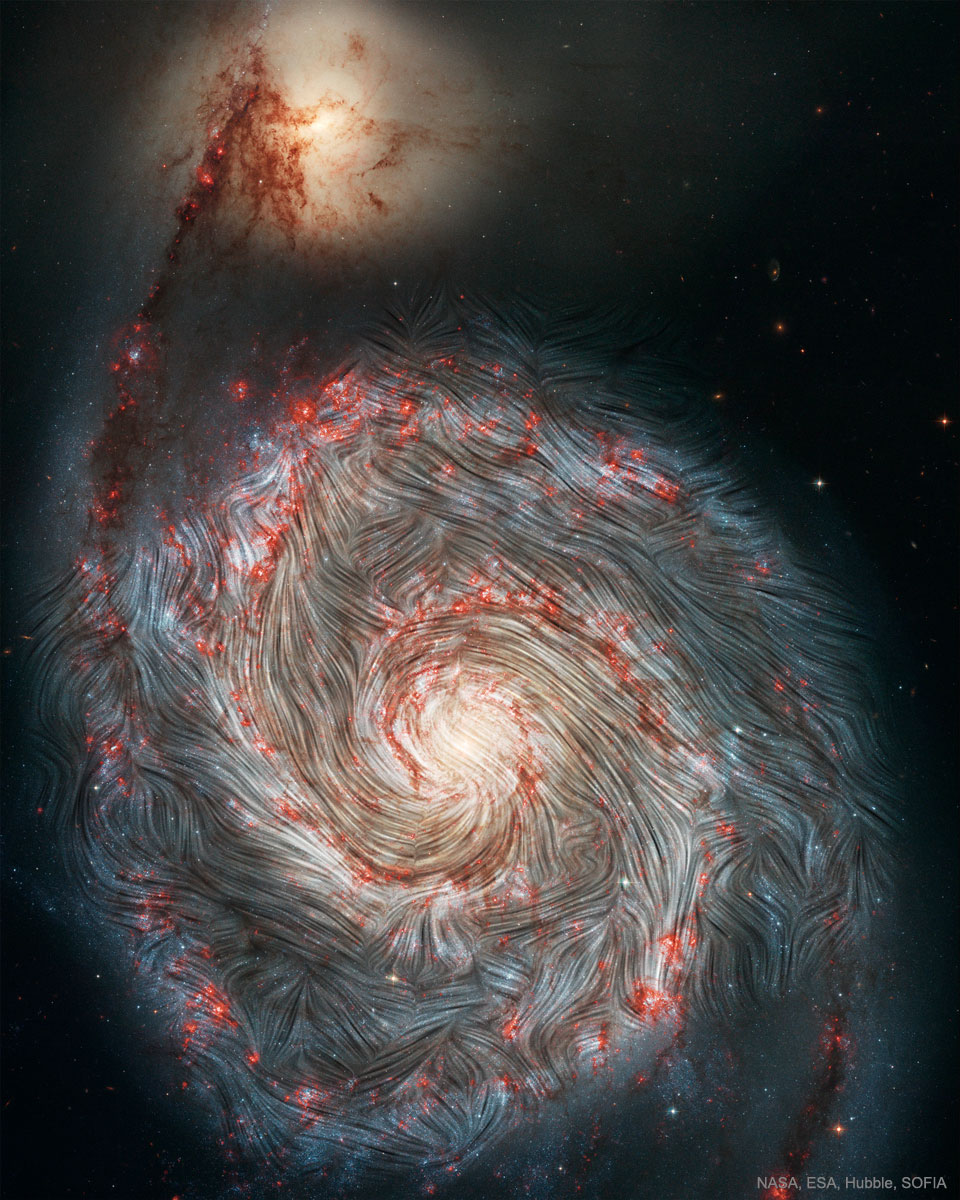
**The Magnetic Field of the Whirlpool Galaxy**
**Image Credit:** [NASA](https://www.nasa.gov/), [SOFIA](https://www.nasa.gov/mission_pages/SOFIA/overview/index.html), [HAWC+](https://www.nasa.gov/ames/image-feature/one-of-a-kind-camera-added-to-sofia), [Alejandro S. Borlaff](https://borlaff.github.io/); [JPL-Caltech](https://www.jpl.nasa.gov/), [ESA](https://www.esa.int/), [Hubble](https://www.nasa.gov/mission_pages/hubble/story/index.html); _Text:_ [Jayanne English](http://www2.physics.umanitoba.ca/u/english/) ([U. Manitoba](https://sci.umanitoba.ca/physics-astronomy/))
**Explanation:** Do magnetic fields always flow along spiral arms? Our face-on view of the [Whirlpool Galaxy](https://apod.nasa.gov/apod/ap190506.html) (M51) allows a spectacularly clear view of the spiral wave pattern in a disk-shaped galaxy. When observed with a [radio telescope](https://en.wikipedia.org/wiki/Radio_telescope), the [magnetic field appears](https://apod.nasa.gov/apod/ap191216.html) to [trace the arms’ curvature](https://www.mpifr-bonn.mpg.de/research/fundamental/cosmag). However, with NASA’s flying [Stratospheric Observatory for Infrared Astronomy](https://www.nasa.gov/mission_pages/SOFIA/overview/index.html) (SOFIA) observatory, the [magnetic field](https://www.universetoday.com/76515/magnetic-field/) at the outer edge of [M51’s disk](https://youtu.be/yiv6a8BVzPE) appears to weave across the arms instead. Magnetic fields are inferred by [grains of dust](https://astronomy.swin.edu.au/cosmos/D/Dust+Grain) aligning in one direction and acting [like polaroid glasses](https://www.baumer.com/ch/en/service-support/technology-highlights/polarization/a/Polarization) on [infrared light](https://science.nasa.gov/ems/07_infraredwaves). In the [featured image](https://www.nasa.gov/feature/magnetic-chaos-hidden-within-the-whirlpool-galaxy), the field orientations determined from this polarized light are [algorithmically connected](https://en.wikipedia.org/wiki/Line_integral_convolution), creating [streamlines](https://youtu.be/6UlsArvbTeo). Possibly the gravitational tug of the [companion galaxy](https://en.wikipedia.org/wiki/NGC_5195), at the top of the frame, on the dusty gas of the reddish star-forming regions, visible in the [Hubble Space Telescope image](https://hubblesite.org/contents/media/images/2005/12/1677-Image.html), enhances [turbulence](https://youtu.be/5zI9sG3pjVU) – stirring the dust and lines to produce the unexpected field pattern of the outer arms.
2021-01-21T08:00:00Z

**M78 Wide Field**
**Image Credit & [Copyright](https://apod.nasa.gov/apod/lib/about_apod.html#srapply):** [Wes Higgins](https://www.astrobin.com/users/wes63/)
**Explanation:** [Interstellar](http://www-ssg.sr.unh.edu/ism/what1.html) dust clouds and [glowing nebulae](https://nasaviz.gsfc.nasa.gov/12086) abound in the fertile [constellation of Orion](https://apod.nasa.gov/apod/ap161204.html). One of the [brightest, M78](http://www.messier.seds.org/m/m078.html), is centered in this colorful, [wide field view](https://www.astrobin.com/wj6sox/?nc=user), covering an area north of [Orion’s belt](https://apod.nasa.gov/apod/ap171123.html). At a distance of about 1,500 light-years, the bluish reflection nebula is around 5 light-years across. Its tint is due to dust [preferentially](http://leo.astronomy.cz/mix/mix.html) reflecting the [blue light](http://math.ucr.edu/home/baez/physics/General/BlueSky/blue_sky.html) of hot, young stars. Reflection nebula NGC 2071 is [just to the left](http://www.starpointing.com/ccd/m78_labeled.html) of M78. Flecks of emission from [Herbig-Haro objects](https://en.wikipedia.org/wiki/Herbig%E2%80%93Haro_object#Discovery_and_history_of_observations), energetic jets from stars in the process of formation, stand out against the dark dust lanes. The exposure also brings out the region’s fainter, pervasive reddish glow of atomic hydrogen gas.

**The Milky Ring**
**Image Credit & [Copyright](https://apod.nasa.gov/apod/lib/about_apod.html#srapply):** [Alvin Wu](https://www.instagram.com/alvinwufoto/)
**Explanation:** An expanse of cosmic dust, stars and nebulae along the plane of our Milky Way galaxy form a beautiful ring in [this projected all-sky view](https://www.instagram.com/p/CKRCvdhpBxH/?igshid=1nk6qdc78twez). The creative panorama covers the entire [galaxy visible](https://apod.nasa.gov/apod/ap180427.html) from planet Earth, an ambitious 360 degree mosaic that took two years to complete. Northern hemisphere sites in western China and southern hemisphere sites in New Zealand were used [to collect](https://apod.nasa.gov/apod/ap110730.html) the image data. Like a glowing jewel set in the milky ring, the bulge of the [galactic center](https://www.nasa.gov/mission_pages/chandra/news/a-new-galactic-center-adventure-in-virtual-reality.html), is at the very top. Bright planet Jupiter is the beacon just above the central bulge and left of red giant star [Antares](https://apod.nasa.gov/apod/ap200516.html). Along the plane and almost 180 degrees from the galactic center, at the bottom of the ring is the area [around Orion](https://apod.nasa.gov/apod/ap161204.html), denizen of the northern hemisphere’s evening winter skies. In this projection the ring of the Milky Way encompasses two notable galaxies in southern skies, the large and small [Magellanic clouds](https://apod.nasa.gov/apod/ap210101.html).
---
### Author:  [@JPS838898](https://forum.eternagame.org/u/JPS838898)
#### Post date: [February 2, 2021, 12:53am UTC](https://forum.eternagame.org/t/astronomy-picture-of-the-day/3754/12 "2021-02-02T00:53:59Z")
2021-01-23T08:00:00Z
 **Recycling Cassiopeia A**
**Image Credit:** X-ray - [NASA](https://www.nasa.gov/), [CXC, SAO](http://chandra.harvard.edu/); Optical - [NASA,STScI](http://www.stsci.edu/)
**Explanation:** Massive stars in our Milky Way Galaxy live spectacular lives. Collapsing from vast cosmic clouds, their nuclear furnaces ignite and create heavy elements in their cores. After a few million years, the [enriched material](https://apod.nasa.gov/apod/ap190801.html) is blasted back into interstellar space where star formation can begin anew. The expanding debris cloud known as Cassiopeia A is an example of this final phase of the stellar life cycle. Light from the explosion which created this supernova remnant would have been first [seen in planet Earth’s sky](http://spider.seds.org/spider/Vars/casA.html) about 350 years ago, although it took that light about 11,000 years to reach us. [This false-color image, composed of X-ray and optical image data](https://www.nasa.gov/mission_pages/chandra/images/the-latest-look-at-first-light-from-chandra.html) from the Chandra X-ray Observatory and Hubble Space Telescope, shows the still hot filaments and knots in the remnant. It spans about 30 light-years at the estimated distance of Cassiopeia A. High-energy X-ray emission from specific elements has been color coded, silicon in red, sulfur in yellow, calcium in green and iron in purple, to help [astronomers explore](https://arxiv.org/abs/1111.7316) the recycling of our galaxy’s [star stuff](https://apod.nasa.gov/apod/ap171119.html). Still expanding, the outer blast wave is seen in blue hues. [The bright speck](https://apod.nasa.gov/apod/ap170501.html) near the center is a neutron star, the incredibly dense, collapsed remains of the massive stellar core.
2021-01-24T08:00:00Z
 **Massive Nearby Spiral Galaxy NGC 2841**
**Image Credit:** [NASA](https://www.nasa.gov/), [ESA](https://esahubble.org/), [Hubble](https://hla.stsci.edu/), [Subaru](https://subarutelescope.org/en/about/); **Composition & Copyright:** [Roberto Colombari](https://www.facebook.com/roberto.colombari)
**Explanation:** It is one of the more massive galaxies known. A mere 46 million light-years distant, spiral galaxy [NGC 2841](https://hubblesite.org/image/3845/printshop) can be found in the northern constellation of [Ursa Major](https://apod.nasa.gov/apod/ap070108.html). This sharp view of the gorgeous [island universe](https://cass.ucsd.edu/public/tutorial/Galaxies.html) shows off a striking yellow nucleus and galactic disk. Dust lanes, small, pink star-forming regions, and young blue star clusters are embedded in the patchy, tightly [wound](https://casa.colorado.edu/~danforth/science/spiral/) [spiral](https://apod.nasa.gov/apod/ap030925.html) arms. [In contrast](https://apod.nasa.gov/apod/ap091017.html), many other spirals exhibit grand, sweeping arms with large [star-forming](https://science.nasa.gov/astrophysics/focus-areas/how-do-stars-form-and-evolve) regions. NGC 2841 has a diameter of over 150,000 [light-years](https://exoplanets.nasa.gov/faq/26/what-is-a-light-year/), even larger than [our own](http://www.atlasoftheuniverse.com/galaxy.html) Milky Way. The featured composite image merges exposures from the orbiting 2.4-meter [Hubble Space Telescope](https://www.nasa.gov/mission_pages/hubble/story/index.html) and the ground-based 8.2-meter [Subaru Telescope](https://www.naoj.org/en/about/). [X-ray images](https://chandra.harvard.edu/photo/2006/n2841/) suggest that resulting winds and stellar explosions create plumes of hot gas extending into a halo around [NGC 2841](https://www.youtube.com/watch?v=byMG1s47ov8).
2021-01-25T08:00:00Z
 **Southern Cross over Chilean Volcano**
**Image Credit & Copyright:** [Tomáš Slovinský](http://slovinsky.art/en/homeen/)
**Explanation:** Have you ever seen the Southern Cross? This famous four-star icon is best seen from Earth’s Southern Hemisphere. The featured image was taken last month in [Chile](https://en.wikipedia.org/wiki/Chile) and captures the [Southern Cross](https://www.constellation-guide.com/the-southern-cross/) just to the left of erupting [Villarrica](https://youtu.be/gmZ1q9_Cdtg), one of the most active [volcanos](https://en.wikipedia.org/wiki/Villarrica_(volcano)) in [our Solar System](https://solarsystem.nasa.gov/solar-system/our-solar-system/overview/). Connecting the reddest Southern Cross star Gacrux through the brightest star [Acrux](https://en.wikipedia.org/wiki/Acrux) points near the most southern location in the sky: the [South Celestial Pole](https://apod.nasa.gov/apod/ap210101.html) (SCP), around which all southern stars appear to spin [as the Earth turns](https://apod.nasa.gov/apod/ap200701.html). In [modern times](https://i.ytimg.com/vi/17PkUsTVa7g/maxresdefault.jpg), no bright star resides near the SCP, unlike in the north where bright [Polaris](https://apod.nasa.gov/apod/ap150602.html) now appears near the NCP. [Extending the Gacrux - Acrux line](https://en.wikipedia.org/wiki/Celestial_pole#/media/File:Pole01-eng.jpg) still further (from about four to about seven times their angular separation) leads near the [Small Magellanic Cloud](https://youtu.be/ssQyxCijfr8), a bright satellite galaxy of our Milky Way Galaxy. The Southern Cross [asterism](https://en.wikipedia.org/wiki/Asterism_(astronomy)) dominates the Crux constellation, a [deeper array of stars](https://earthsky.org/favorite-star-patterns/the-southern-cross-signpost-of-southern-skies) that includes four [Cepheid variable stars](https://youtu.be/QcChCeX2VrY) visible to the unaided eye. Just above the volcano in the image, and looking like a dark plume, is the [Coalsack Nebula](https://en.wikipedia.org/wiki/Coalsack_Nebula), while the large red star-forming [Carina](https://apod.nasa.gov/apod/ap200505.html) Nebula is visible on the upper left.2021-01-26T08:00:00Z

**Central NGC 1316: After Galaxies Collide**
**Image Credit:** [NASA](https://www.nasa.gov/), [ESA](https://www.esa.int/), [Hubble](https://www.nasa.gov/mission_pages/hubble/about); _Processing & Copyright:_ [Daniel Nobre](https://www.astrobin.com/users/Deep_Sky/)
**Explanation:** How did this strange-looking galaxy form? [Astronomers](https://www.astronomynotes.com/careers/AAS-careerbrochure-2009.pdf) turn detectives when trying to figure out the cause of unusual jumbles of stars, gas, and dust like NGC 1316. Inspection indicates that NGC 1316 is an enormous [elliptical galaxy](https://en.wikipedia.org/wiki/Elliptical_galaxy) that somehow includes dark dust lanes usually found in a [spiral galaxy](https://en.wikipedia.org/wiki/Spiral_galaxy). Detailed images taken by the [Hubble Space Telescope](https://esahubble.org/about/faq/) shows details, however, that help in reconstructing the history of this [gigantic tangle](https://i.pinimg.com/originals/fe/3e/d7/fe3ed7e7796e5cac54b9f68447ec7d82.jpg). Deep and wide images show [huge collisional shells](https://apod.nasa.gov/apod/ap170202.html), while deep central images reveal fewer [globular clusters](https://apod.nasa.gov/apod/ap190324.html) of stars toward NGC 1316’s interior. Such effects are expected in galaxies that have undergone collisions or merging with other [galaxies](https://spaceplace.nasa.gov/galaxy/en/) in the past few billion years. The dark knots and lanes of [dust](https://apod.nasa.gov/apod/ap030706.html), prominent in the [featured image](https://www.astrobin.com/za9jwh/D/), indicate that one or more of the devoured galaxies were spiral galaxies. [NGC 1316](https://en.wikipedia.org/wiki/NGC_1316) spans about 50,000 light years and lies about 60 million [light years](https://chandra.harvard.edu/photo/cosmic_distance.html) away [toward](https://youtu.be/hFboxodn7ZM) the constellation of the Furnace ([Fornax](https://en.wikipedia.org/wiki/Fornax)).
2021-01-27T08:00:00Z

**The Vertical Magnetic Field of NGC 5775**
**Image Credit:** [NRAO](https://public.nrao.edu/), [NASA](https://www.nasa.gov/), [ESA](https://www.esa.int/), [Hubble](https://www.nasa.gov/mission_pages/hubble/about); _Processing & Text:_ [Jayanne English](http://www2.physics.umanitoba.ca/u/english/) ([U. Manitoba](https://sci.umanitoba.ca/physics-astronomy/))
**Explanation:** How far do magnetic fields extend up and out of spiral galaxies? For decades astronomers knew only that some [spiral galaxies](https://en.wikipedia.org/wiki/Spiral_galaxy) had [magnetic field](https://en.wikipedia.org/wiki/Magnetic_field)s. However, after [NRAO](https://public.nrao.edu/)’s Very Large Array ([VLA](https://apod.nasa.gov/apod/ap060514.html)) [radio telescope](https://en.wikipedia.org/wiki/Radio_telescope) (popularized in the [movie Contact](https://en.wikipedia.org/wiki/Contact_(1997_American_film))) was [upgraded](https://science.nrao.edu/facilities/vla/docs/manuals/oss2013B/intro/project) in 2011, it was [unexpectedly discovered](https://i.imgur.com/MwLMgEJ.jpeg) that these fields could extend vertically away from the disk by several thousand [light-years](https://spaceplace.nasa.gov/light-year/en/). The [featured image](https://public.nrao.edu/news/2020-image-contest-winners/) of [edge-on spiral](https://apod.nasa.gov/apod/ap100225.html) galaxy [NGC 5775](https://en.wikipedia.org/wiki/NGC_5775), observed in the CHANG-ES ([Continuum Halos in Nearby Galaxies](https://www.queensu.ca/changes/)) survey, also reveals spurs of magnetic field lines that [may be common](https://www.queensu.ca/changes/press-releases/) in spirals. Analogous to [iron filings around a bar magnet](https://youtu.be/tfiebTsJDno), radiation from electrons trace [galactic magnetic field lines](https://apod.nasa.gov/apod/ap210120.html) by spiraling around these lines at almost the [speed of light](https://youtu.be/nQUwHdSAhmw). The filaments in this image are [constructed](https://illuminateduniverse.org/2021/01/27/the-yin-and-yang-of-the-visible-and-invisible-in-spiral-galaxies/) from those tracks in VLA data. The [visible light](https://science.nasa.gov/ems/09_visiblelight) image, [constructed from](https://sites.google.com/site/jayannescosmicportfolio/) [Hubble Space Telescope](https://www.nasa.gov/mission_pages/hubble/story/index.html) data, shows pink gaseous regions where [stars are born](https://science.nasa.gov/astrophysics/focus-areas/how-do-stars-form-and-evolve). It seems that [wind](https://apod.nasa.gov/apod/ap190723.html)s from these regions help form the magnificently [extended galactic magnetic fields](https://ui.adsabs.harvard.edu/abs/2020A%26A...639A.112K/abstract).
2021-01-28T08:00:00Z

**Messier 66 Close Up**
**Image Credit:** [NASA](http://www.nasa.gov/), [ESA](http://www.esa.int/), [Hubble](https://www.nasa.gov/mission_pages/hubble/story/index.html); _Processing & Copyright:_ [Leo Shatz](https://www.astrobin.com/users/spinlock/)
**Explanation:** Big, beautiful [spiral galaxy Messier 66](https://www.nasa.gov/feature/goddard/2017/messier-66) lies a mere [35 million light-years away](https://esahubble.org/images/heic1006a/). The gorgeous island universe is about 100 thousand light-years across, similar in size to the Milky Way. [This reprocessed](https://www.astrobin.com/qzaary/B/?nc=user) [Hubble Space Telescope](https://www.nasa.gov/connect/ebooks/not-yet-imagined.html) close-up view spans a region about 30,000 light-years wide around the galactic core. It shows the galaxy’s disk dramatically inclined to our line-of-sight. Surrounding its bright core, the likely home of a supermassive black hole, obscuring dust lanes and young, blue star clusters sweep [along spiral arms](https://apod.nasa.gov/apod/ap100413.html) dotted with the tell-tale glow of pinksh star forming regions. Messier 66, also known as NGC 3627, is the brightest of the three galaxies in the gravitationaly interacting [Leo Triplet](https://apod.nasa.gov/apod/ap190418.html).
2021-01-29T08:00:00Z

**North American Nightscape**
**Composite Image Credit & [Copyright](https://apod.nasa.gov/apod/lib/about_apod.html#srapply):** [Liron Gertsman](https://www.facebook.com/lirongertsmanphotography/)
**Explanation:** On January 21, light from the Moon near first quarter illuminated the foreground in this snowy mountain and night scene. Known as The Lions, the striking pair of mountain peaks are north of [Vancouver](https://visibleearth.nasa.gov/images/76775/vancouver-canada), British Colombia, Canada, North America, planet Earth. Poised above the twin summits, left of Deneb alpha star of the constellation [Cygnus](https://apod.nasa.gov/apod/ap190725.html), are emission regions [NGC 7000 and IC 5070](https://apod.nasa.gov/apod/ap171201.html). Part of a large star forming complex about 1,500 light-years from Vancouver, they shine with the characteristic red glow of atomic hydrogen gas. Outlines of the bright emission regions suggest their popular names, The North America Nebula and The Pelican Nebula. [The well-planned, deep nightscape](https://www.instagram.com/p/CKebYGxgNvS/) is a composite of consecutive exposures made with a modified digital camera and telephoto lens. Foreground exposures were made with camera fixed to a tripod, background exposures were made tracking the sky. The result preserves sharp natural detail and reveals a range of brightness and color that your eye [can’t quite see on its own](https://apod.nasa.gov/apod/ap200326.html).
2021-01-30T08:00:00Z

**Southern Sky from 38,000 Feet**
**Image Credit & [Copyright](https://apod.nasa.gov/apod/lib/about_apod.html#srapply):** [Ralf Rohner](https://www.instagram.com/skypointer2000/)
**Explanation:** Celestial sights of the southern sky shine above a [cloudy planet Earth](https://www.nasa.gov/image-feature/cloudy-earth) in this gorgeous night sky view. The scene was captured from an airliner’s flight deck at 38,000 feet on a steady westbound ride to Lima, Peru. To produce [the sharp airborne astrophotograph](https://www.flickr.com/photos/skypointer2000/50869832177/), the best of a series of short exposures were selected and digitally stacked. The broad band of the [southern Milky Way](https://apod.nasa.gov/apod/ap170821.html) begins at top left with the dark [Coalsack Nebula](https://oneminuteastronomer.com/2036/coalsack-nebula/) and Southern Cross. Its expanse of diffuse starlight encompasses the the Carina Nebula and large Gum Nebula toward the right. Canopus, alpha star of Carina and second brightest star in Earth’s night is easy to spot below the Milky Way, as is the dwarf galaxy known as the [Large Magellanic Cloud](https://en.wikipedia.org/wiki/Galaxies_in_fiction#Large_Magellanic_Cloud). The Small Magellanic cloud just peeks above the cloudy horizon. Of course, the South Celestial Pole also lies [within the starry southern frame](https://apod.nasa.gov/apod/ap210101.html).
2021-01-31T08:00:00Z

**Asteroids in the Distance**
**Image Credit:** [NASA](https://www.nasa.gov/), [ESA](https://www.esa.int/), [Hubble](https://www.nasa.gov/mission_pages/hubble/main/index.html); R. Evans & K. Stapelfeldt ([JPL](https://www.jpl.nasa.gov/))
**Explanation:** Rocks from space hit Earth every day. The larger the rock, though, the less often Earth is struck. Many kilograms of space dust pitter to Earth daily. Larger bits appear initially as a bright [meteor](https://solarsystem.nasa.gov/asteroids-comets-and-meteors/meteors-and-meteorites/in-depth/). Baseball-sized rocks and ice-balls streak through our atmosphere daily, most evaporating quickly to nothing. [Significant threats](https://cneos.jpl.nasa.gov/sentry/) do exist for rocks near 100 meters in diameter, which [strike the Earth](https://en.wikipedia.org/wiki/Meteor_Crater#/media/File:Meteorcrater.jpg) roughly every 1000 years. An object this size could cause [significant tsunamis](https://link.springer.com/article/10.1007/s11069-020-04086-6) were it to strike an ocean, [potentially devastating](https://astronomy.com/news/2020/12/common-misconceptions-about-doomsday-asteroid-impacts) even distant shores. A collision with a [massive asteroid](https://www.boredpanda.com/size-of-asteroids-alvaro-gracia-montoya/), over 1 km across, [is more rare](https://en.wikipedia.org/wiki/Impact_event#/media/File:SmallAsteroidImpacts-Frequency-Bolide-20141114.jpg), occurring typically millions of years apart, but [could have truly global consequences](https://cneos.jpl.nasa.gov/sentry/intro.html). Many asteroids remain [undiscovered](https://spacewatch.lpl.arizona.edu/). In the [featured image](https://hubblesite.org/image/616/category/39-asteroids), one such asteroid – shown by the long blue streak – was found by chance in 1998 by the Hubble Space Telescope. A [collision](https://apod.nasa.gov/apod/ap050308.html) with a large asteroid would not [affect Earth](https://youtu.be/4Wrc4fHSCpw)’s orbit so much as [raise dust](https://www.youtube.com/watch?v=95tmYmeHf84) that would [affect Earth’s climate](https://en.wikipedia.org/wiki/Impact_winter). One likely result is a global extinction of many species of life, possibly dwarfing the ongoing [extinction occurring now](https://en.wikipedia.org/wiki/Holocene_extinction).
2021-02-01T08:00:00Z

**Lunar Halo over Snowy Trees**
**Image Credit & Copyright:** [Göran Strand](http://www.astrofotografen.se/)
**Explanation:** Have you ever seen a halo around the [Moon](https://solarsystem.nasa.gov/moons/earths-moon/in-depth/)? This fairly common sight occurs when [high thin clouds](https://en.wikipedia.org/wiki/Cirrus_cloud) containing millions of tiny [ice crystals](http://en.wikipedia.org/wiki/Ice_crystals) cover much of the sky. Each [ice crystal](https://www.atoptics.co.uk/halo/circ1.htm) acts like a miniature lens. Because [most](http://www.everythingweather.com/lightning/ice.shtml) of the crystals have a similar elongated hexagonal shape, light entering one crystal face and exiting through the opposing face refracts 22 degrees, which corresponds to the radius of the [Moon Halo](https://www.atoptics.co.uk/halo/circmoon.htm). A similar [Sun Halo](https://apod.nasa.gov/apod/ap150403.html) may be visible during the day. Exactly [how ice-crystals form](http://www.cas.manchester.ac.uk/resactivities/cloudphysics/topics/formation/) in clouds remains a topic of research. In the [featured image](https://www.instagram.com/p/CKgTQ8BhJ1y/) taken last week from [Östersund](https://youtu.be/E0z1BqhtyLA), [Sweden](https://en.wikipedia.org/wiki/Sweden), a complete [lunar halo](https://apod.nasa.gov/apod/ap200224.html) was captured over [snowy trees](https://apod.nasa.gov/apod/ap170110.html) and [rabbit](https://www.rd.com/wp-content/uploads/2020/04/GettyImages-694542042-e1586274805503.jpg) tracks.