Delta is the difference between the target and natural state shown in upper right hand corner of puzzle screen. Puzzle solvers are addicted to delta because they “walk” it down to zero to solve a puzzle. Doubt if it works in this type of lab.
1 Like
Yes, Rhiju is testing whether raising the energy in state 2 as calculated by Eternafold will improve copyability. Perhaps the ribozyme is too tightly paired to unfold for making a copy? But raising the energy too much probably will disrupt the catalytic activity.
I wonder if there are any pilot designs that scored well on copying by weakening the bonds in a stem (replacing GC with AU) while maintaining some catalytic activity?
Well done, Ucad! As everyone can see now, the sensitive areas primarily are the unpaired strands. That leaves us plenty of stems to play with raising energy.
2 Likes
I believe denszok has some designs that used that strategy: ( by weakening the bonds in a stem (replacing GC with AU) and scored well balancing the copyability and catalytic activity.
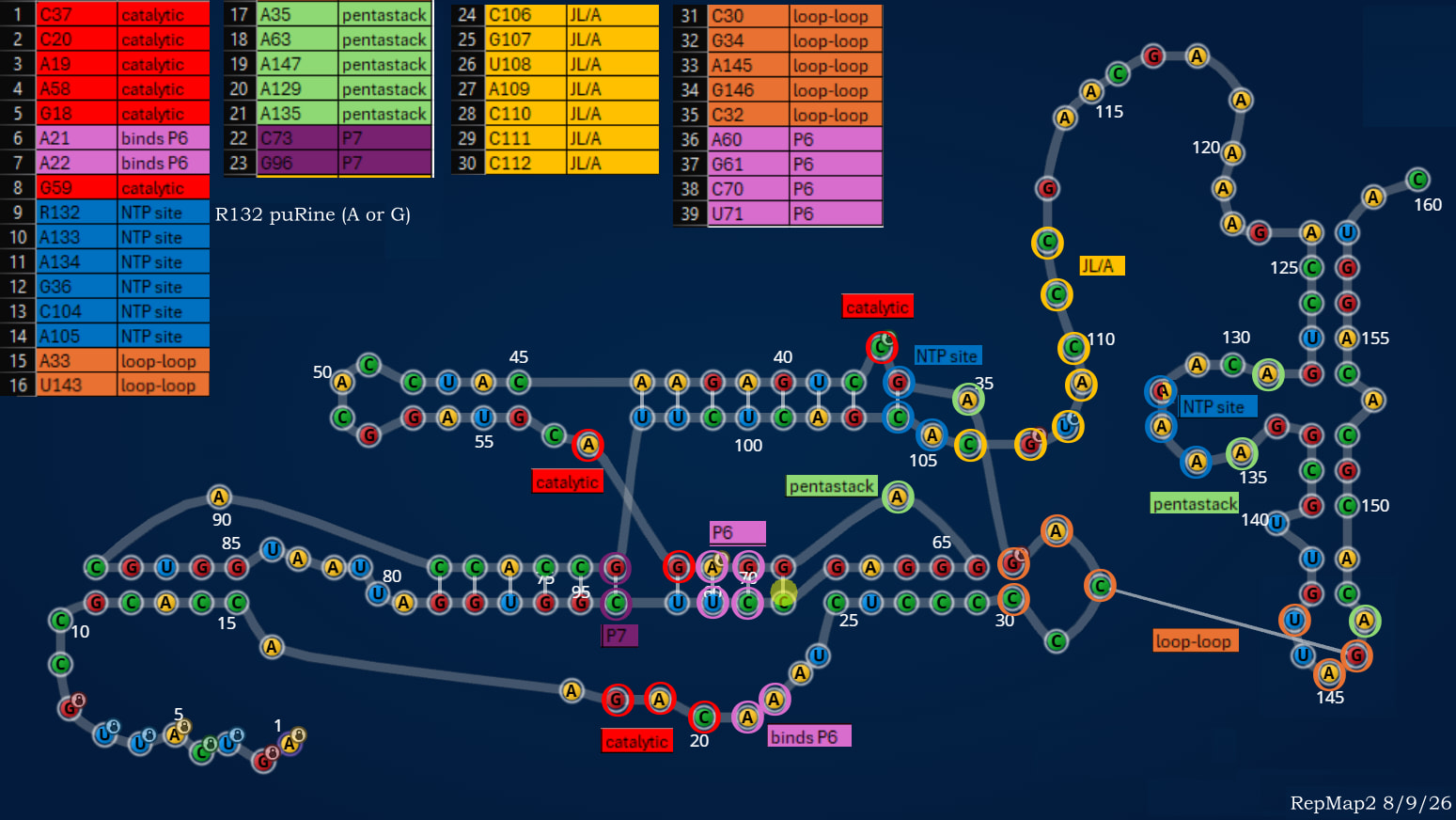
Hey, after looking at this I realized I also messed up U144 - its supposed to be U143 that I wouldn’t mess with. If I notice anything more I will update my list and let you know here, in case you want to also update this mapping. 
2 Likes
I also missed something at the NTP site. A133 should be conserved, and the R should be at position 132, not 133 as previously. This also means that A135 isn’t part of the NTP group. Sorry for the confusion. I think I was looking at a secondary structure with a single nucleotide deletion that shifted all the numberings in the accessory domain. I hope that’s all of them.
2 Likes
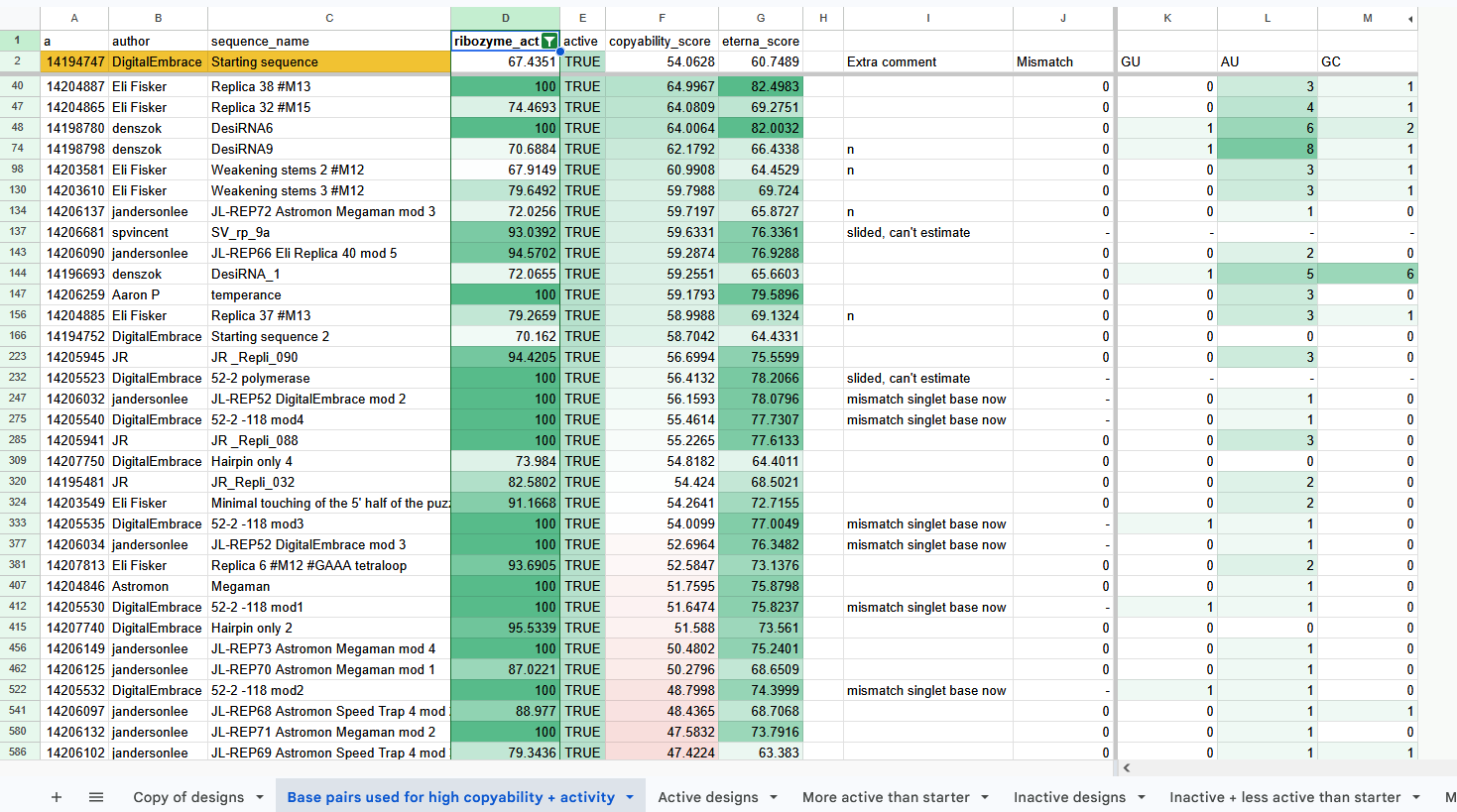
@DigitalEmbrace, I have counted the identity of base pair (only those that are changed) in designs that have good copyability while still maintaining activity.
I can also confirm what @JR1 mentioned on designs like Denszok’s using adding in more AU’s. I will just add that Aaron P did the same in his temperance. His specific stated strategy was:
“I’m afraid of breaking it so I made few mutations based on purine-pyrimidine identity. No idea if that means anything”
With just adding 3 AU base pairs, he managed to raise copyability from 54.0628 to 59.1793 and ribozyme activity from 67.4351 to 100. I hope to see more variations on it.
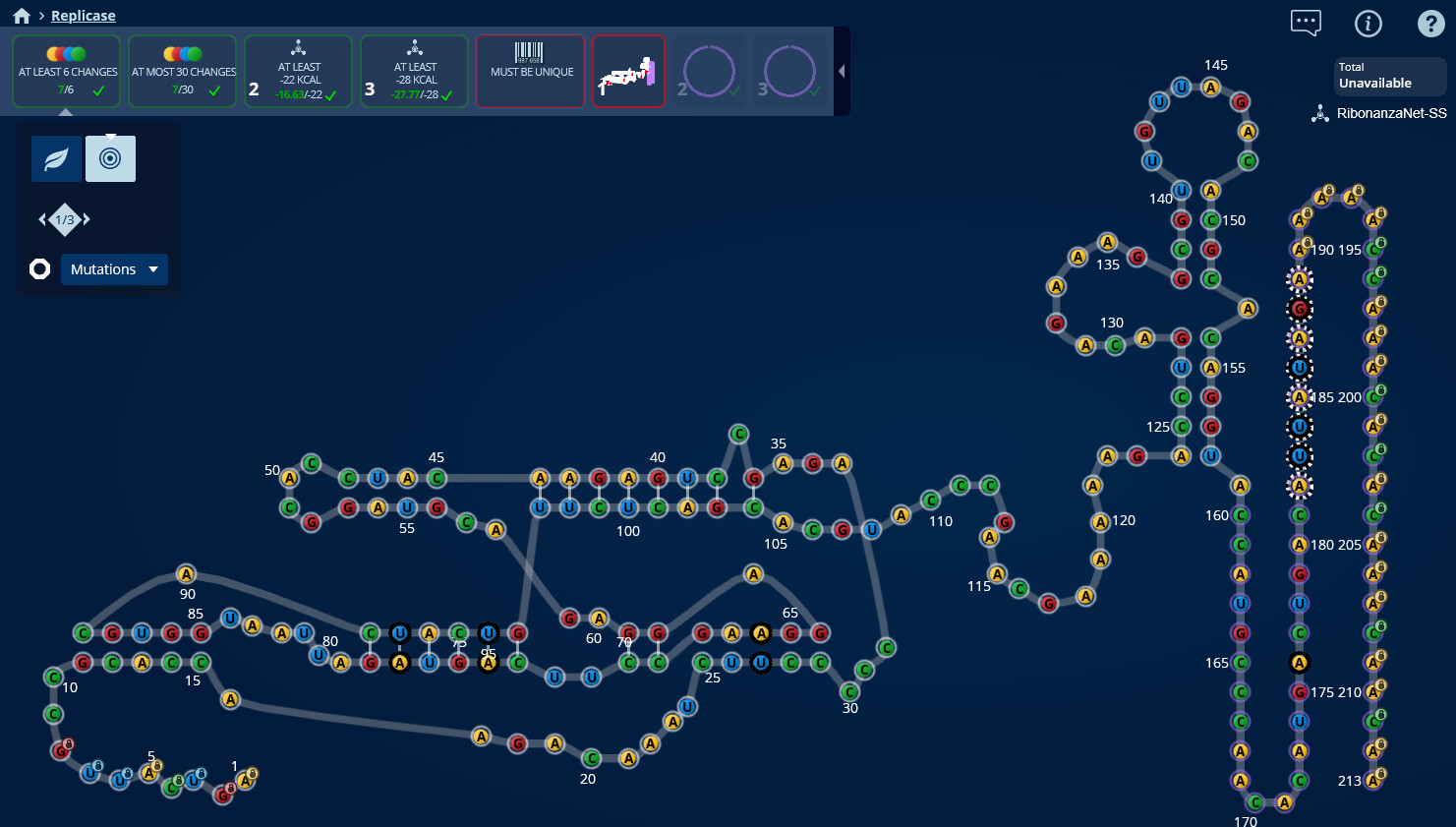
Some of mine used a similar strategy. By replacing GC’s with AU’s and AU’s with GC’s. Thereby also keeping pyrimidine and purines the same.
You asked for designs that scored well on copying while remaining active and if they tended to weaken bonds. I have added a sheet with data for this. There do seem to be a trend for those to have more changes to AU’s than GC’s.
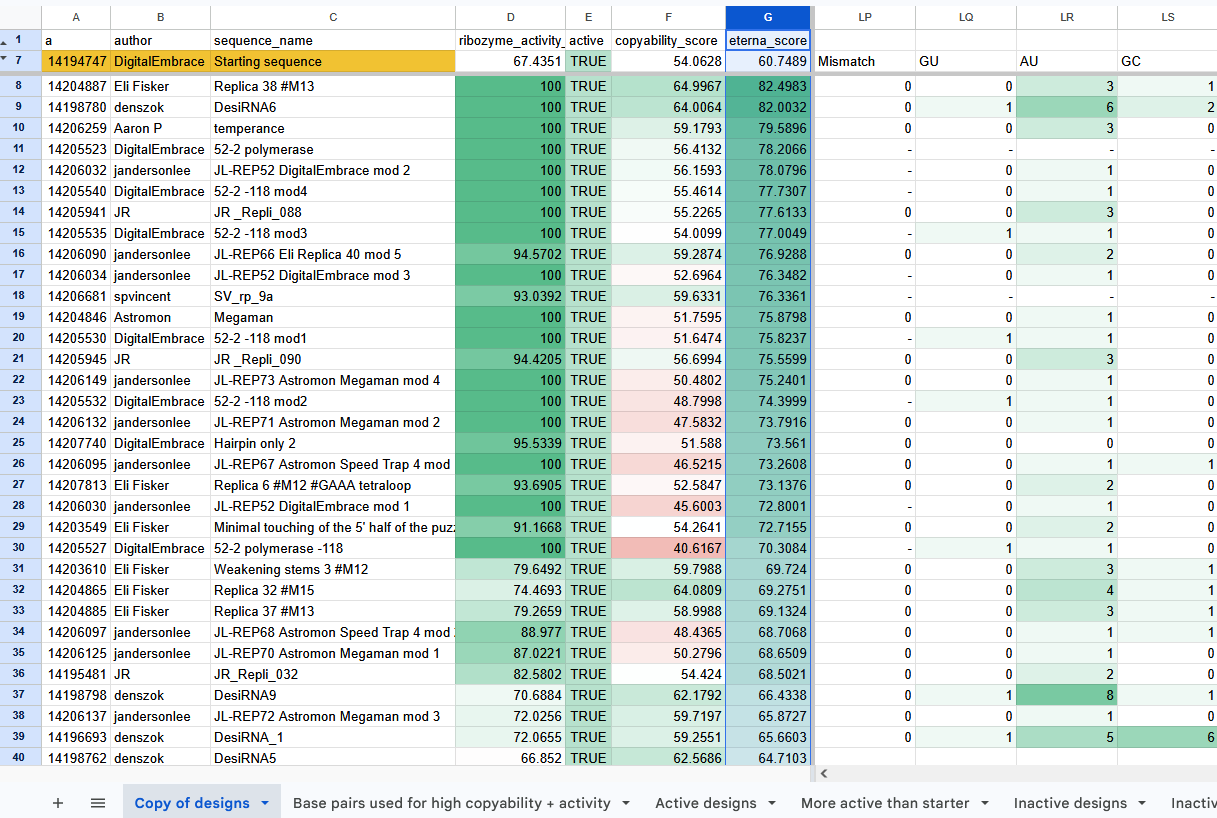
This in general also goes for most of the designs that score well in Eterna. That the base pairs changed into AU’s are more than those changed into GC.
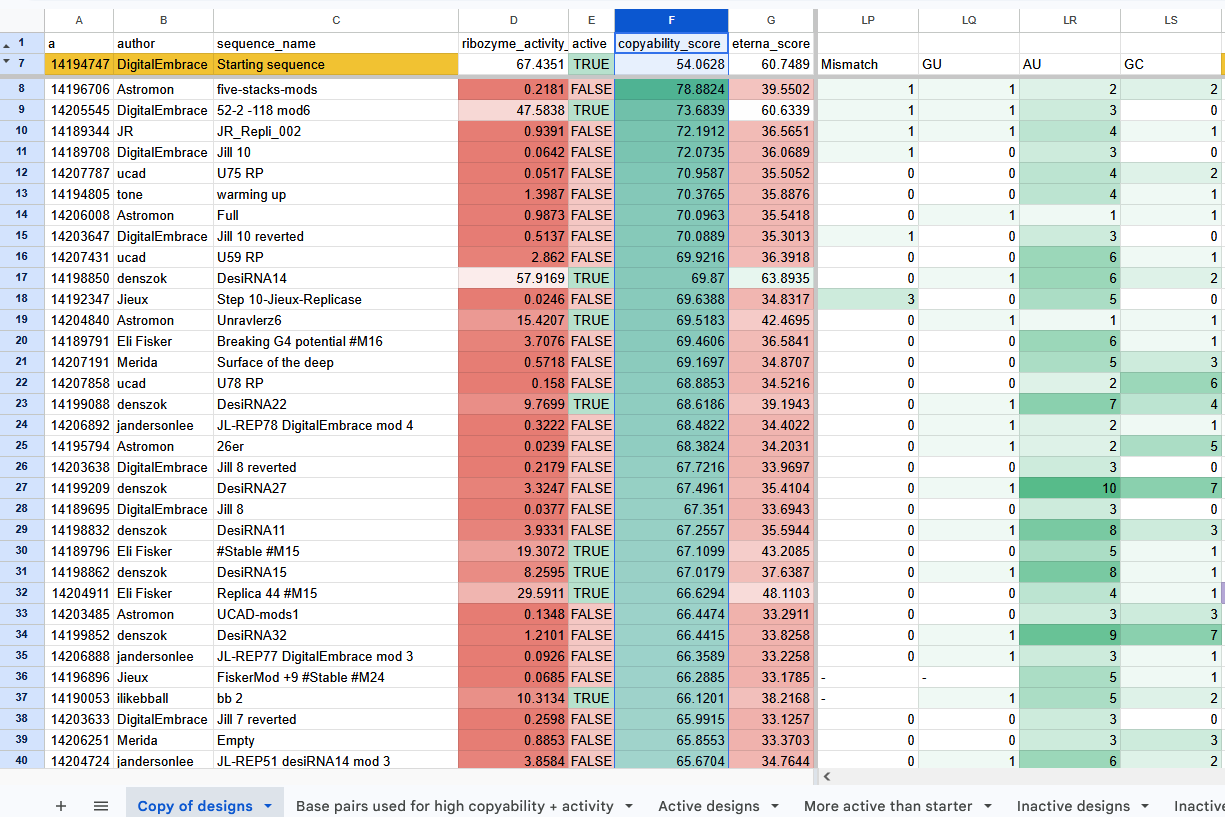
When I however sort for designs that are highly copyable but not limiting for activity another pattern pops up. A good deal of those introduce mismatches in stems or more GU. They are highly copyable, but the majority of them have broken critical areas and most of them have lost ribozyme activity or score lower than the starter sequence. They tend to have an even higher AU to GC ratio than the earlier design groups. A good deal of them most likely break critical structure.
1 Like
For me it looks like it’s going to be a tradeoff:
Decreasing stack total energy increases copyability but doing so by creating long pseudoknots. no stack pseudoknots, or a reduction in stack pseudoknot count (relative to the original stack) reduces activity.
Hi, Thanks! Can we get a list error-free for copy paste. I am a little confused whether the above graph and list are correct or not. (Welcome in!)
Found one last mistake, i think after this it is perfect:
Instead of U144 it should be U143 that is conserved.
Yeah, I just checked the latest map from @ucad, and found one last mistake on my part (should be U143 instead of U144), and its all good.
The current list in my original post is the correct one.
2 Likes
Is the structure in the RCSB database? Or perhaps it might be available in a form readable by ChimeraX?
The PDB of the cryo-EM was released this morning: RCSB PDB - 37SO: tC19Z RNA polymerase ribozyme, apo state along with a paper preprint on the cryo-EM. The Das Lab posted about it on Bluesky: @rdaslab.bsky.social on Bluesky
1 Like
The structure solved is of tC19Z, an ‘ancestor’ (via in vitro lab evolution) of our sequence 71-89. Note that it has a non-productive interaction, described in the preprint https://www.biorxiv.org/content/10.64898/2026.08.14.744467v1
that is not likely present in 71-89.
To help you look at our Eterna puzzle’s starting 71-89 sequence, Chaitanya Joshi and I have prepared models of its apo (ribozyme alone) and holo (with bound primer, template, and NTPs) with a couple of different modeling methods here:
One of these models is the 3D coordinates shown in Eterna – enjoy inspecting the rest in ChimeraX!
1 Like
Also, some of you may have noted that designs based on the “52-2” sequence by @DigitalEmbrace and @jandersonlee were super active.
This 52-2 an ‘ancestor’ of the 71-89 starting sequence and it might be fruitful to go back in lab evolution and check other ancestors or cousins of our starting sequence.
For example I was reading a paper from the Holliger lab on ‘4M’ which doesn’t require as much magnesium and has elaborated a purine-rich bulge near the active site. Perhaps installing those mutations would allow destabilization elsewhere?
To help everyone look at these prior ribozymes, I’m making the paper available under fair use in a single Google Drive: ReplicaseReferencesFairUse - Google Drive
Looking forward to seeing what you get!
1 Like
Tx! (I assume it’s 71_89_apo_FARFAR2_model1_ETERNA.pdb).
Is there a way of changing nucleotide colours in ChimeraX. It’s quite confusing the way it used the same colours as Eterna but with different nucleotides.
This should work in the ChimeraX command line to set Eterna colors:
color :A yellow target f; color :C green target f; color :G red target f; color :U blue target f
2 Likes
That worked : tx
1 Like
I suggest that for future puzzles of this type there should be no locked bases. They present a real problem when trying to slide sequences around.
1 Like