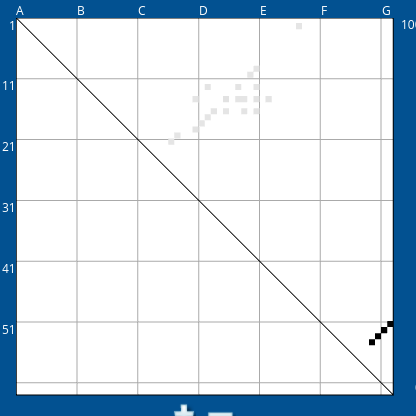
Being largely unpairedshould not necessarily result in low confidence. If you look at the dot plot, it’s not that it can’t decide which pairs to choose - it actually doesn’t think there will be any other pairs
Also worth noting that values between 0.001 and 0.1 are shown as 0.1 for readability’s sake, so those errant pairing probabilities are probably quite low
I aim to first make as much of the puzzle stable as I can. If I have a very weak part with boost spots around, then I run the Mutation/Submission booster at the boost spot. That is only 16 mutations, which help make it less painful on large puzzles. So it is faster than hand mutation and one is not forgetting any. This strategy I repeat on other unboosted areas where there is a single pair (or other small stem) with instabilities.
Alternatively, if there is only a single pair with two boost spots around that I have already run, but the single pair is still unstable, then I may run the booster on all these 4 boost bases. But only if this is the last unstable spot. Then I will also consider running the 16 mutation run on the neighbors to a boost spot.
Same mutation trick can be used on zigzag bulges. Mark the two bulge bases and run the mutation booster on them.
This more unusual boost behavior happens mainly in puzzles with short stems, lots of loops/unpaired regions, few available GC’s, when a loop is attached to another loop (multiloop, internal loop etc) and a combo of these. Basically with structurally pressured designs. I would normally call it energetically pressured designs, but we are not having an energy engine here.
Additional solving tip:
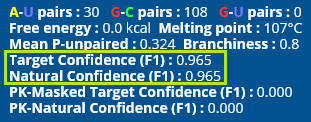
I try to balance the F1 scores - as can be found in RNA specs. Sometimes getting the F1 numbers even will solve the puzzle, just as if it was energy. Or if I’m not working in a pseudoknot, the numbers give me valuable information about if some pseudoknots pairs are forming - unwanted. Then I can avoid making these changes. I do not only watch if the Target confidence and Natural confidence gets closer, I also watch if their numbers get up.
I just won the RNet Gladius sword using the strategies above.
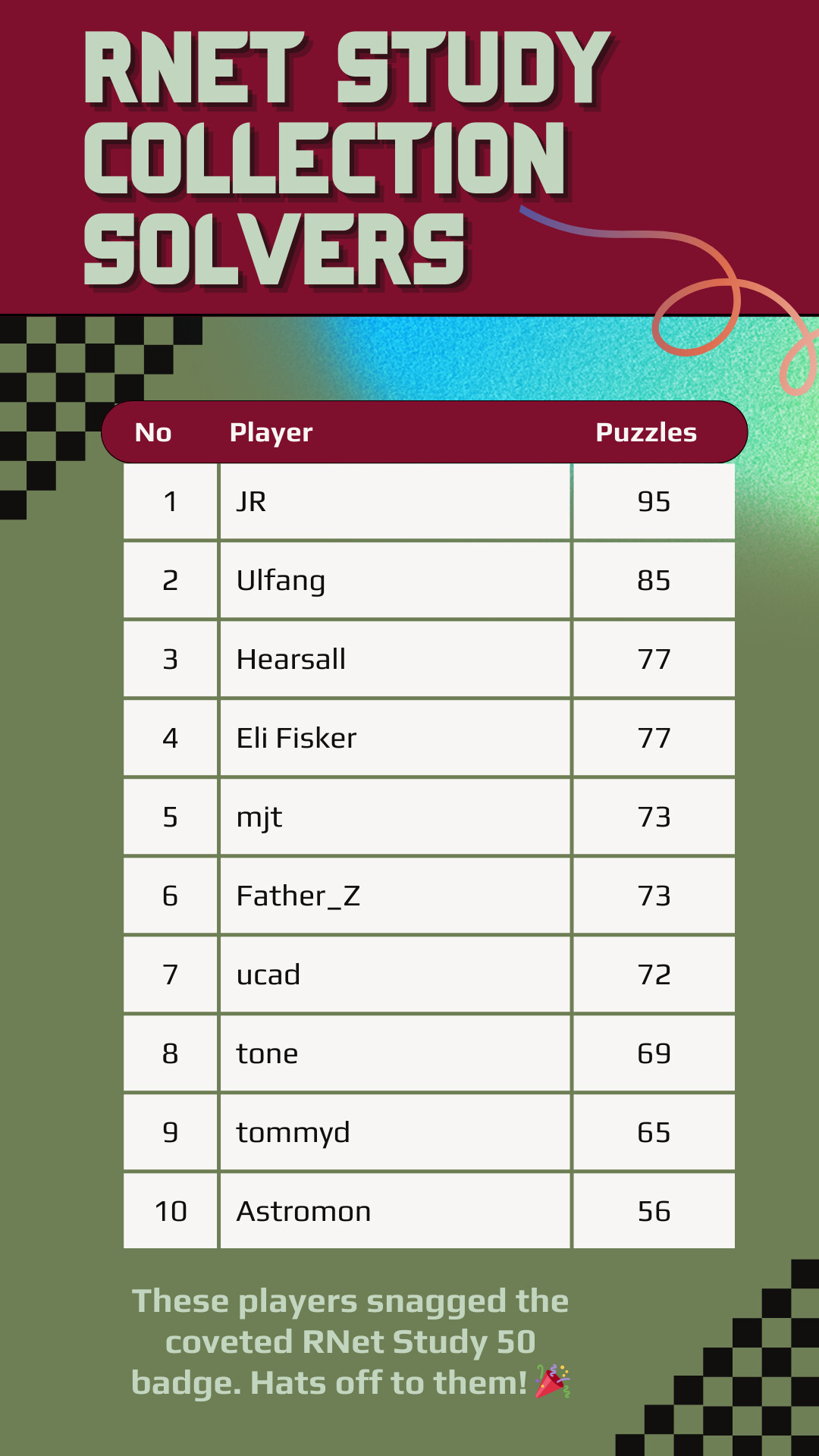
Since one of the current puzzles in the collection likely is unsolvable (3F2X) and four puzzles are extremely difficult, I’m considering adding eight new puzzles to the collection so that players can earn the 100-puzzle badge. The other option is to remove the five Z-solvers and replace those with five new puzzles, and I reveal the solution sequence of the four difficult puzzles for which I have a solution.
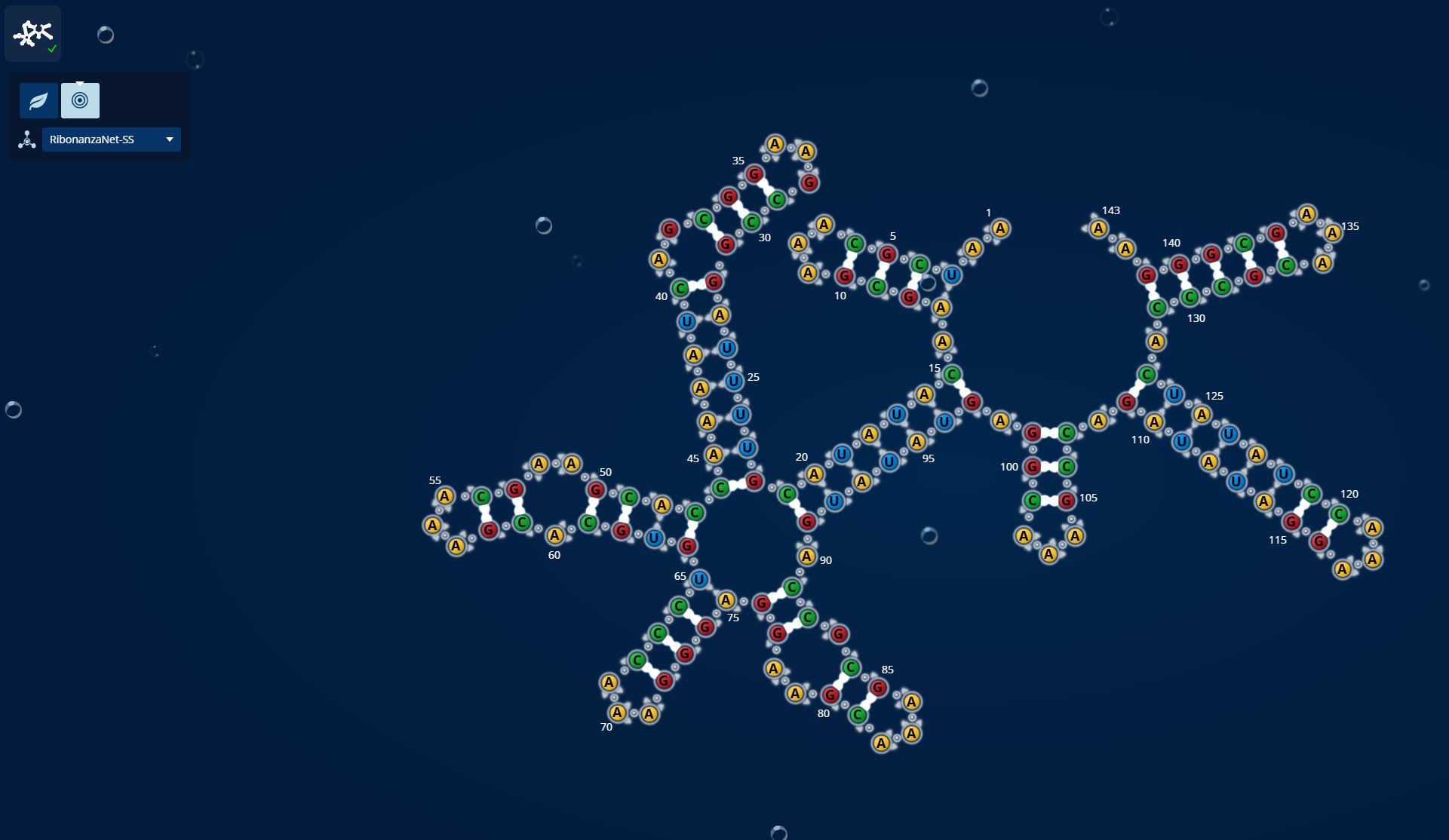
Thx for your demonstration. This is helpful. I hadn’t realize that we could work with Ribonanza in the puzzlemaker. I thought we had to go to dev for doing that. So while we can’t publish here, having RNet in the puzzlemaker is still useful.
Now that we are really good are pseudoknot design (as evidenced by the new pseudoknot design paper), there may be a need for more pseudoknotted secondary structures for a design challenge in the next year or two. Interested players can continue making pseudoknotted secondary structures on eternadev.org. Any length. The longer 240 length probably would be particularly useful and interesting.
Also, feel free to post puzzles on dev that look wrong and impossible to solve as I’d like to revisit the feasibility of enabling RNet-SS publishing on the main site Puzzlemaker at some point. Eterna probably should add RNet 2 to our engine list, but that is driven by researcher need. If players can show RNet 2 is vastly superior to RNet 1, then that would help push our research benefactors towards funding RNet 2 implementation.
RNet could use something complementary to check whether it’s making enough pairings. RNet will leave large amounts of G and C unpaired if the predicted probabilities of specific pairings are low or similar, and then F1 is high if the surviving pairs have stable designs.
For some tasks the most important part is keeping a specific part of the sequence unpaired. Knowing which bases have a high probability of being paired is useful even if specific pairings have low confidence. Like in my example earlier in the thread of 5 GGGCCC palindromic repeats with 0 predicted pairings it’d still be helpful to know that each GGGCCC has a roughly 80% chance to be paired. Would summing all the predicted pairing probabilities for each base be feasible?
(Also, did we ever figure out the cause of the weirdness in the pair probability plots? Like when it shows a solid black smear of A pairing with A?)
One way to test RNet is to open the EFTK puzzles you created or solved on the main site, beam to puzzlemaker, switch to RNet, and check if the structure still folds. I bet the oddball structures don’t fold in RNet. I checked one of mine - the RNet prediciton was very different.